[EOR/IOR Series ⑦] Customs Delay Costs in Korea: Protecting AI Data Center and Automation Projects

Updated: Sep 27
Originally published 18 July 2026, Korea time · HOSOON CHOI
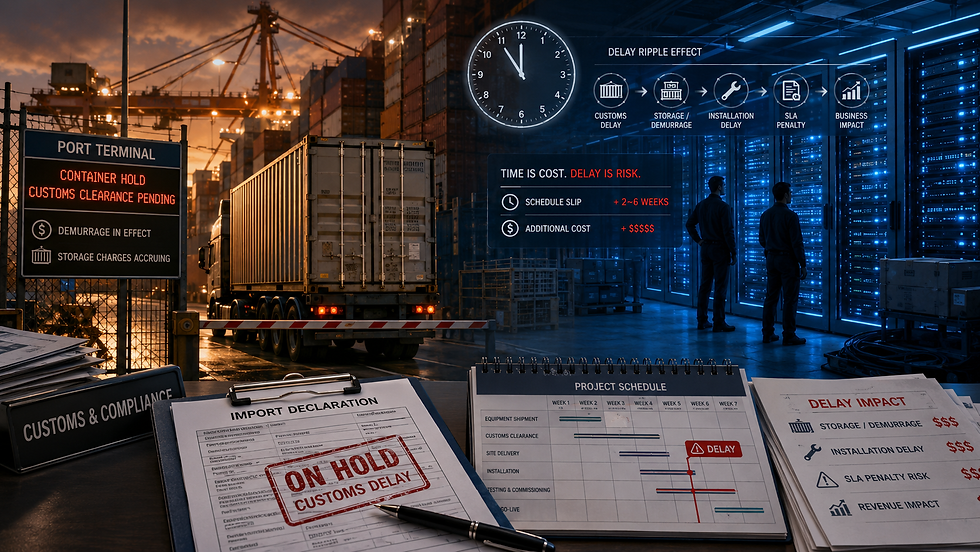
A shipment held at customs can affect far more than its warehouse bill. For a company building an AI data center, manufacturing facility or automated warehouse in Korea, a late component may change installation, commissioning and customer acceptance dates. The effect depends on what that component enables and how much flexibility remains in the schedule.
GPU servers, racks, switches, optical modules, power supplies, uninterruptible power supplies (UPS), batteries, cooling equipment and security devices have different technical characteristics. A factory project adds robots, control cabinets, sensors, automated guided vehicles (AGVs) and autonomous mobile robots (AMRs). Treating them all as “IT equipment” or “automation parts” makes it harder for the import team to understand the shipment.
Put customs readiness into the project schedule
The Korea Customs Service explains that incomplete declarations or supporting documents can require correction or delay clearance. See its import declaration guidance.
The practical response is to prepare before dispatch. Give each shipment a latest acceptable site-delivery date, identify the work that depends on it, and check whether its documents and responsible parties are ready. A small controller can deserve more attention than a costly machine if the controller is needed for the next integration test.
Preparation reduces avoidable uncertainty; it cannot guarantee release on a particular day. Inspections, transport disruption and other events still need contingency time and an escalation plan.
Five costs to assess separately
1. Storage and care of the equipment
Ask where the goods will wait, how charges are calculated, and who controls access. High-value servers, robots and sensitive components may have packaging, shock, humidity or temperature requirements. Battery-related equipment may need particular handling arrangements.
Confirm responsibility for insurance, condition checks, opening packages for inspection, and repacking. A low storage rate is not a complete answer if the proposed facility cannot meet the equipment’s handling needs.
2. Container demurrage and detention
Broadly, demurrage concerns container time inside a terminal; detention concerns time outside it. The applicable contract controls free time and charging. Maersk’s terms illustrate these distinctions.
Ask the carrier or forwarder to confirm the actual last free dates, calculation method, separate storage charges, and empty-container return arrangements for this shipment. Do not treat a general explanation as a Korean port tariff. A late delivery slot or slow unloading can also affect the return plan after customs release.
3. Waiting and rescheduling at the site
Truck bookings, cranes, forklifts, specialist handling teams and installation engineers may all require new appointments. Overseas engineers already in Korea may face additional accommodation or travel changes. Record the applicable cancellation, standby and remobilization terms instead of assuming every delayed day has the same cost.
Check the actual delivery conditions: unloading space, access routes, lift capacity, floor loading, security permissions, work hours and site safety requirements. These require confirmation against the equipment and site; generic dimensions or load limits are insufficient.
4. A disrupted installation sequence
Rack installation, power testing, cooling readiness and network integration have dependencies. An AGV or AMR installation may need chargers, controllers, safety devices and interfaces before commissioning. A missing cable or sensor can prevent a test even when the principal equipment is present.
Separate critical items from items with schedule float. Identify work that can continue safely and any approved alternatives. Do not substitute an unverified component or bypass a safety function to recover time.
5. Acceptance and contractual exposure
Delivery, installation completion, customer acceptance and service launch are different milestones. A service-level agreement (SLA) or delay clause may attach consequences to particular events, but customs delay does not automatically establish a penalty or a party’s liability.
Review the actual contract, notice obligations, allocation of responsibility and evidence with the relevant commercial or legal advisers. Keep additional cash costs separate from estimated lost revenue and reputational effects. Avoid counting the same interruption as several independent losses.
Define IOR/EOR responsibilities in practical terms
Importer of Record (IOR) and Exporter of Record (EOR) are useful project terms, but an acronym alone does not establish an entity’s legal role or eligibility. Record who will be named in the Korean import transaction, who instructs the customs broker, who supplies technical evidence, and who handles duties, taxes and records. A forwarder, customs broker, equipment owner and importing entity may have different responsibilities.
DDP wording deserves a specific check. Under Incoterms® 2020, import clearance falls to the seller under DDP and to the buyer under DAP. ICC Academy explains the distinction.
Before accepting a DDP quotation, identify the workable local arrangement and confirm its scope with the parties. Delivery terms alone are not a substitute for that discussion. For later repairs, replacements, returns or re-export, establish who manages the outbound shipment and preserves the link to the original import records.
Use a pre-shipment readiness checklist
Decision | Evidence to prepare | Person to name |
Importing party and commercial arrangement | Parties, transaction purpose, delivery terms and written scope | Importer and procurement lead |
Item identification and classification | Functional description, model, specifications and component list for review | Supplier and customs broker |
Applicable approvals and controls | Model-specific assessment and supporting documents | Compliance lead with the relevant specialists |
Consistent shipment documents | Invoice, packing list, quantities, units and serial-number mapping where applicable | Supplier and logistics coordinator |
Response to questions or inspection | Technical contact, document access and inspection/repacking arrangements | Importer, broker and supplier |
Release-to-site delivery | Free-time dates, delivery slot, handling plan and installation dependencies | Forwarder and site manager |
For Korean conformity requirements, use the National Radio Research Agency’s guidance and the Korean Agency for Technology and Standards’ electrical safety information as starting points. Verify applicability to the exact product, configuration and intended use; not every device follows the same route. Where relevant, review batteries, dangerous-goods transport, export controls, end user and end use with qualified parties before shipment. Do not assume an overseas certificate, an “industrial use” description or a replacement-parts label settles every requirement.
Also describe whether the movement is a sale, loan, lease, demonstration, repair or replacement. A single commercial package may contain hardware, software and services. Provide the transaction details for valuation review rather than inventing a nominal equipment value or assuming a no-charge replacement has no customs value.
Compare readiness and total exposure, not freight alone
Air freight shortens the transport leg; unresolved documents can still prevent onward delivery. Compare options using the date the equipment can realistically become available at the site, including clearance, handling and access conditions.
Build a scenario worksheet using the project’s own rates and schedule. List storage and container charges, inspection or repacking costs, changed transport, standby and remobilization separately. Then identify which delays would actually affect the critical path. Use clear assumptions and avoid adding uncertain opportunity costs to confirmed invoices as though they were equivalent.
Free time is a contractual allowance, not a guarantee that the project has enough buffer. Agree who monitors its expiry and when the team must escalate. A named owner, current evidence and an achievable recovery option are more useful than a promise that everything will clear quickly.
Turn the shipment plan into a scoped discussion
For an initial Korea automation or infrastructure review, prepare the equipment list and specifications, transaction purpose and parties, origin and destination, proposed dates, and the installation milestone at risk. These inputs help identify gaps in the import and site-delivery plan.
Detailed classification, approval strategy, contracting structure, engineering and a firm integrated quotation require the actual documents and an agreed scope with the relevant specialists. HOSOON CHOI’s platform offers a free quote and consultation request in Korean and English. You can also contact hci@hosoonchoi.com.


Comments